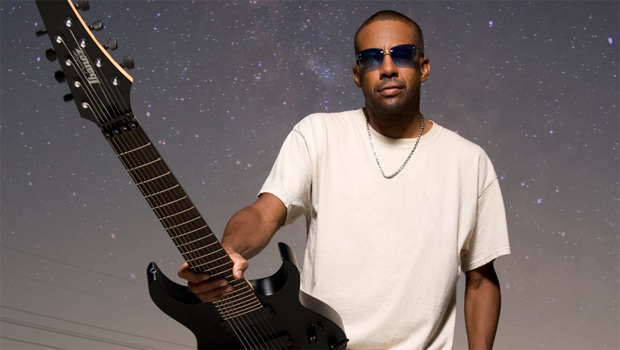
The Renaissance Man of Shred: Decoding Tony MacAlpine
In the 1980s, if you wanted to be a guitar hero, you usually needed two things: enough hairspray to punch a hole in the ozone layer and a burning desire to play faster than a hummingbird on an espresso bender. Then there was Tony MacAlpine. While everyone else was busy trying to look like they’d just survived an explosion in a spandex factory, MacAlpine arrived with the quiet confidence of a man who could out-shred you on guitar and then out-play you on piano before you even finished tuning your E-string.
From Chopin to Chugging Riffs
Born in 1960 in Springfield, Massachusetts, Tony didn't start his musical journey with a Garage Sale Stratocaster. He started at the age of five as a classically trained pianist. He spent twelve years at the Springfield Conservatory of Music and later the University of Hartford, soaking in the works of Frédéric Chopin.
It wasn't until he was twelve that he picked up the guitar. Most people spend decades trying to master one instrument; Tony decided to master two at the same time. His "origin story" is essentially a warning to every other musician: he’s a classically trained violinist and pianist who just happened to decide that distorted guitars were also pretty cool.
The Varney Discovery
In 1984, the legendary talent scout Mike Varney—the man responsible for finding basically every guitar wizard of that era—stumbled upon Tony’s demo. Varney featured him in his "Spotlight" column in Guitar Player magazine. By 1986, Tony released Edge of Insanity, an album that featured Billy Sheehan on bass and Steve Smith on drums. It wasn't just a "guitar record"; it was a masterclass in composition that actually sold over 100,000 copies in the US—a feat nearly unheard of for niche instrumental music.
The Neoclassical Rivalry (That Wasn’t)
You can’t talk about MacAlpine without mentioning Yngwie Malmsteen. In the 80s, the "Neoclassical" genre was the Wild West of shred. While Yngwie brought the fire, fury, and a penchant for Ferraris, Tony brought a "warmer" and more academic approach.
He didn't just "ape" Yngwie’s style; he integrated complex jazz-fusion and actual classical literature into his playing. In fact, on almost every MacAlpine record, you’ll find a solo piano performance of a Chopin étude. It’s his way of reminding us that while he can melt your face with a seven-string guitar, he’s just as comfortable in a tuxedo at a grand piano.
The Gear: More Strings, More Power
Tony isn't afraid of technology. While some purists cling to their vintage six-strings, MacAlpine has spent the last two decades pushing the boundaries of seven and eight-string guitars.
- Guitars: After years as a staple of Carvin (the T-Mac series), he moved to Ibanez. He’s frequently seen with customized RG Prestige models loaded with EMG or DiMarzio pickups.
- Amps: He is a long-time devotee of Hughes & Kettner. In the studio, he prefers the TriAmp for its pure tube tone, but on the road, he uses the Coreblade.
- The Secret Weapon: He’s a massive fan of the Ernie Ball Wah pedal. He uses it for "tone-shaping" rather than just the "wah-wah" cliché, adding color to his leads that most shredders overlook.
Studio Hermit or Road Warrior?
Tony has spent seven years touring with Steve Vai, played in the fusion supergroup CAB, and delved into progressive metal with Planet X. He has admitted that while playing in front of people brings him "great joy," he loves the "construction" of music in the studio. He often writes entire records by himself using a drum computer, preserving the "first-take energy" of his demos for the final cut.
Life Beyond the Fretboard
When he isn't busy being a one-man orchestra, what does a virtuoso do? Tony has joked that if he ever lost his musical "response," he might finally pick up some golf clubs. For now, though, his hobbies seem to be largely... more music. He is constantly reading new piano literature and finding ways to translate it to the guitar.
What the Pros Say
His peers don’t just respect him; they’re slightly terrified of him. Steve Vai famously invited Tony into his band to play both guitar and keyboards, often having Tony double Vai’s most insane leads on the keys simultaneously.
"He’s a special kind of low because he’s too good of a player," joked one fan on a forum, reflecting the general sentiment that MacAlpine is simply a musical anomaly.
Whether he’s performing a Chopin prelude or a sweep-tapping masterclass, Tony MacAlpine remains the "musician’s musician"—the guy who reminds us all that "shredding" is a lot more than just playing fast; it’s about having something to say.
The Essential Starter Pack
- Edge of Insanity (1986): This is the "big bang" where Tony proves he can out-shred your favorite hair metal guitarist while casually playing Chopin on the piano better than a concert hall pro.
- Maximum Security (1987): Widely considered his masterpiece, this album is basically a textbook on how to write catchy melodies that still require twelve fingers to play.
- Freedom to Fly (1992): A bit more polished and "90s," showing that Tony wasn't just a relic of the 80s shred boom but a composer who could actually write a song you'd hum in the shower.
- Chromaticity (2001): This is where things get "nerdy" (in a good way) as he leans harder into jazz-fusion and progressive metal influences, perfect for when you want your brain to hurt a little.
- Tony MacAlpine (2011): His self-titled comeback after a long hiatus features 7 and 8-string guitars that sound heavy enough to move furniture and guest drumming that will make your pulse race.
- Concrete Gardens (2015): A modern masterclass that proves even after decades, Tony’s "off" days are still more technically impressive than most people’s entire careers.
The Soundtrack of Evolution
- Tears of Sahara – The atmosphere here is thicker than the hairspray in 1987; listen for the guest solo by George Lynch and how Tony manages to make a guitar weep without actually using onions.
- Hundreds of Thousands – This is the track where Tony basically tells the laws of physics to mind their own business; it's a flurry of notes that somehow still feels like a coherent song.
- Wheel of Fortune – If you only have three minutes to understand why people worship this guy, this is it; the main riff is as iconic as it is impossible for mere mortals to play correctly.
- Autumn Lords – Neoclassical music can sometimes sound like a robotic typewriter, but Tony gives this one a soul and a melody that you might actually remember five minutes later.
- The King's Cup (Live) – Tony thrives on stage, and this live version proves he doesn't need studio magic to sound like an alien from a more musically advanced planet.
- Key to the City – This is the quintessential "Tony sound"—a perfect blend of technical shredding and the kind of melody that belongs on a movie soundtrack about a futuristic city.
- Sacred Wonder – Here you get a taste of his early 90s evolution where he started focusing even more on "The Groove" while still keeping the shred-factor at a solid 11.
- Concrete Gardens – Welcome to the modern era; listen to the low-end growl of his 7-string guitar and try not to let your jaw hit the floor during the sweep-picking sections.
- Edge of Insanity – The title track of his debut, and frankly, a very accurate description of how you'll feel trying to tap along to it on your steering wheel.
- Chopin Etude No. 4, Op. 10 – Just in case you thought he was only good at guitar, here is Tony casually crushing a piano piece that makes most concert pianists sweat through their tuxedos.
Pro Tip: If you listen to all of these in a row and don't feel a sudden urge to either practice for ten hours or sell your instruments on eBay, you might want to check your pulse. Happy listening!