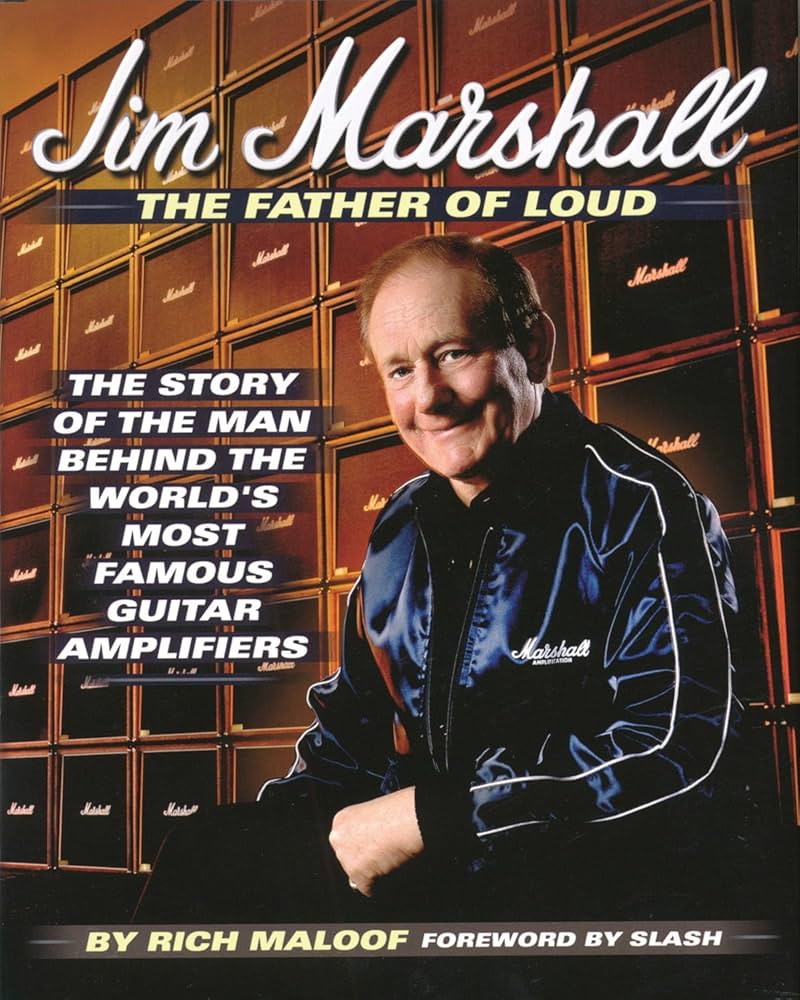
If the history of rock and roll had a volume knob, Jim Marshall is the man who twisted it until it snapped off. We’re not just talking about a brand; we’re talking about the literal backbone of every stadium tour and basement rehearsal for the last 60 years. Before Jim Marshall, guitarists were polite. After him, they were a public nuisance—in the best way possible.
The Boy in the Cast Who Wanted to Sing
Jim Marshall’s life didn’t start with a "Kerrang." Born in 1923, Jim spent his childhood battling tuberculosis of the bones, encased in a plaster cast from his ankles to his chest for years. It’s a bit ironic that the man who would create the world’s most powerful amplifiers started out as a kid who couldn’t even run.
He eventually became a tap dancer to strengthen his legs (seriously), a singer, and a drummer. But Jim had a problem: his voice was too thin to be heard over his drums. Being a handy fellow who worked as an electrical engineer during WWII, he built his own portable PA system. By 1960, he opened a drum shop in Hanwell, London. Because he was a legendary drum teacher with pupils like Mitch Mitchell (Jimi Hendrix Experience), the shop became a magnet for musicians.
One day, a young Pete Townshend and Ritchie Blackmore walked in and basically told Jim that the American Fender amps they were using were "too clean." They wanted something that growled. Jim’s vision wasn’t to conquer the world; he just wanted to give his customers a "sonic weapon" that wouldn't break the bank.
The Evolution of the Roar: Model by Model
Jim didn’t just stumble onto the sound; he and his team (Ken Bran and Dudley Craven) went through six prototypes before hitting the jackpot.
- The JTM45 (1962) – The Birth of "Kerrang": Based on the Fender Bassman circuit but swapped American parts for British ones, warmer and thicker harmonic "bloom."
- The 1959 Super Lead "Plexi" (1965) – The Wall of Sound: Pete Townshend wanted to be deafening, so Jim built the 100-watt beast and the iconic 4x12 stack.
- The JMP & JCM800 (1981) – The Metal King: To give players a "preamp" distortion that could be controlled at lower volumes—perfect for the NWOBHM scene.
- The Silver Jubilee (1987): A special edition for Jim's 50th year, becoming the signature sound for Slash during the Appetite era.
Yngwie Malmsteen: The Master of the Wall
You cannot talk about Marshall without mentioning the Swedish maestro of shred, Yngwie Malmsteen. While most players use a few amps, Yngwie famously uses dozens. His vision of "More is More" fits the Marshall brand like a leather glove.
Yngwie’s tone is built on a specific "pushed" Plexi sound. He uses the 1959 Super Lead almost exclusively, often stacked in literal walls behind him. He doesn't just use them for show; he needs the headroom and the specific "attack" that only a cranked 100-watt Marshall can provide to make his neo-classical sweeps sound like a violin from hell. Marshall eventually honored him with the YJM100, which included a built-in boost and gate—essentially the ultimate Yngwie-in-a-box.
The Impact: From a Garage to a Global Icon
Jim Marshall’s vision was to listen to the "lads" in his shop and build what they needed. He exceeded his original goal of selling 50 amps by, well, several million. The "script" logo—which was actually designed to be easily readable from the back of a concert hall—is now a symbol of rebellion and power.
Jim was awarded an OBE by the Queen for his services to music and charity, proving that even the establishment eventually had to respect the man who made the world 10% louder. He remained "the Governor" until his passing in 2012, but the "Kerrang" he created isn't going anywhere.