The Gibson Chronicle: From Mandolins to Monsters of Rock, and the Fight for the Headstock
A comprehensive dive into the history, the struggles, the lawsuits, and the undeniable tone that made Gibson Guitars an American icon.
If there is a Mount Rushmore of guitar manufacturers, Gibson is undeniably chiseled into the granite alongside Fender. For over a century, the name "Gibson" has conjured images of exquisite craftsmanship, thick, sustaining tone, and rock and roll excess.
But the path from Kalamazoo to Nashville wasn’t a straight line. It is a saga filled with revolutionary invention, baffling corporate missteps, near-death financial experiences, and aggressive legal battles.
This is the story of how a mandolin builder created the tools for Led Zeppelin, Guns N' Roses, and AC/DC, and where the company stands today in a rapidly changing industry.
Chapter 1: The Archtop Origins (1902–1940s)
The story begins not with a guitar, but a mandolin. Orville Gibson, working in Kalamazoo, Michigan, patented a new method for constructing mandolins and guitars in 1898. Instead of constructing the instrument with a flat top and bent sides (like a lute), Orville carved the top and back into an arched shape, similar to a violin.
In 1902, the Gibson Mandolin-Guitar Mfg. Co., Ltd. was incorporated. Orville’s archtop design produced instruments that were louder and more robust than anything else available.
While mandolins paid the bills early on, the 1920s and 30s saw the rise of the guitar in jazz orchestras. Gibson was ready. Under the guidance of designer Lloyd Loar, Gibson introduced the L-5 (1923), the first truly modern archtop guitar with f-holes. It was followed by the massive Super 400 (1934). These instruments set the standard for quality that defined pre-war Gibson.
Chapter 2: The Golden Era—Ted McCarty and the Electric Revolution (1950–1965)
If you own a Gibson today, chances are its design originated in the 1950s. This was Gibson’s undisputed peak of innovation, led by company president Ted McCarty.
Fender had launched the solid-body Telecaster in 1950. Gibson initially scoffed at the "plank," but McCarty knew they had to compete. He enlisted the most famous guitarist in America, Les Paul, to endorse their entry into the solid-body market.
The Essential Golden Era Models:
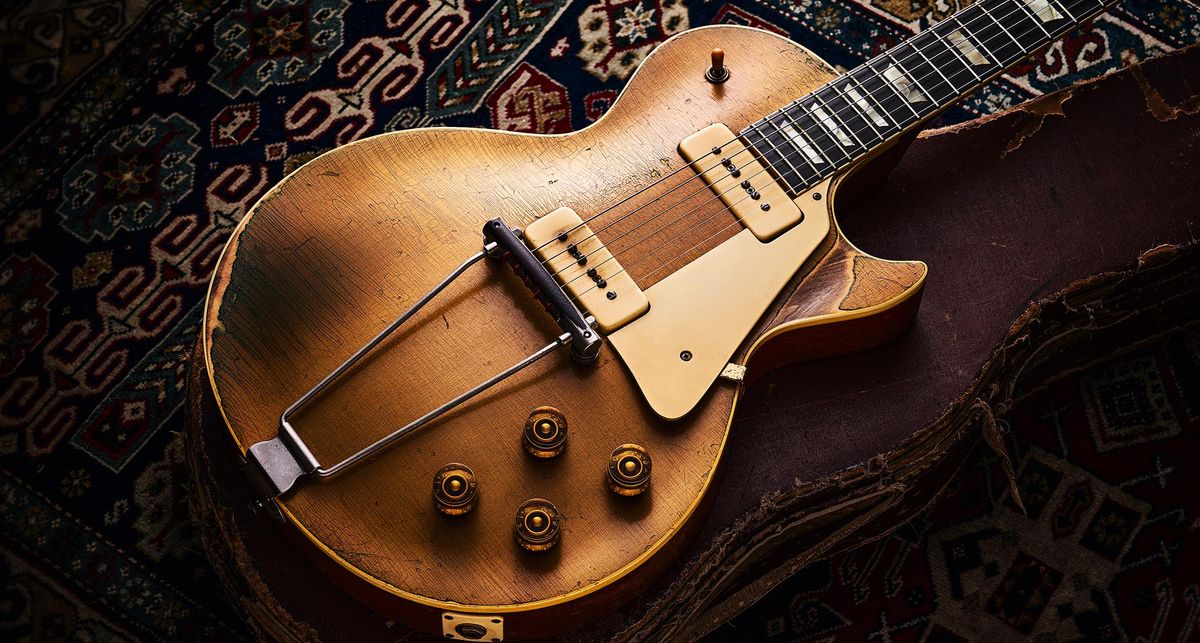
- The Les Paul Model (1952): Originally featuring P-90 single-coil pickups and a gold finish. It evolved quickly. The 1957 addition of the "PAF" (Patent Applied For) humbucker changed everything, culminating in the holy grail of guitars: the 1958–1960 "Sunburst" Les Paul Standard.
- The ES-335 (1958): A stroke of genius by McCarty. A semi-hollow design with a solid center block, it offered the warmth of a hollowbody with the sustain and feedback resistance of a solid body.
- The Modernistic Series (1958): Gibson tried to look futuristic with the Flying V and the Explorer. They were commercial flops at the time, only to become metal icons decades later.
- The SG (1961): Seeking a lighter, sleeker design to boost flagging Les Paul sales, Gibson redesigned the body into a thin, double-cutaway devil horn shape. It was briefly called the "Les Paul SG" until Les Paul objected to the design. It became simply the SG (Solid Guitar).
- The Firebird (1963): Designed by auto designer Ray Dietrich, featuring neck-through construction and mini-humbuckers.
Chapter 3: Why Gibson? The "Preferred" Status
Why did so many players gravitate toward Gibson, especially in contrast to their main rival, Fender? It came down to fundamental design differences that created a different feel and sound:
- The Humbucker Sound: While Fender used bright, snappy single-coils, Gibson pioneered the humbucker. These pickups used two coils to cancel the 60-cycle hum inherent in single-coils. The result was a thicker, warmer, darker, and more powerful sound that pushed amplifiers into overdrive more easily. It was the sound of heavy rock.
- Set-Neck Construction: Fender bolted their necks onto the body. Gibson glued theirs in via a mortise and tenon joint. This "set-neck" construction is widely believed to offer better sustain and resonance.
- Scale Length: Most Gibsons use a 24.75" scale length (shorter than Fender’s 25.5"). This means lower string tension, making string bending easier and giving the guitar a slinkier feel.
- Aesthetics of Luxury: Compared to the utilitarian, modular nature of Fender, Gibsons looked like fine furniture. Carved maple tops, elaborate binding, and mother-of-pearl inlays screamed quality.
Chapter 4: The "Dark Ages"—The Norlin Era (1969–1986)
In 1969, Gibson’s parent company was acquired by ECL, which became Norlin Industries. This period is infamous among Gibson aficionados.
Gibson moved much of its production from Kalamazoo to Nashville. To cut costs and increase production, Norlin made several design changes that players hated: laminated "pancake" bodies, multi-piece maple necks instead of mahogany, and the dreaded "volute" (a bump on the back of the headstock intended to prevent breaks).
Quality control plummeted. The brand lost its way, introducing oddities like the Marauder and the Sonex, which failed to capture the magic of the golden era.
Chapter 5: The Renaissance and The Fall (1986–2018)
By the mid-80s, Gibson was near death. In 1986, Henry Juszkiewicz and David Berryman bought the company for a reported $5 million.
Gibson was saved. Juszkiewicz (known as "Henry J") immediately focused on restoring quality and returning Gibson to vintage specs. The 1990s were a strong decade for Gibson, fueled by the rise of Guns N' Roses (Slash was crucial to making the Les Paul cool again) and the grunge movement.
The 2018 Bankruptcy
However, the 2000s and 2010s saw Henry J make fatal errors. He attempted to transform Gibson from a guitar company into a "music lifestyle brand."
Gibson went on a massive, debt-fueled spending spree, acquiring consumer electronics companies like Philips' audio division, TEAC, and Onkyo. Simultaneously, they forced unpopular "innovations" onto players, most notably the 2015 lineup which forced the "G-Force" robotic tuning system onto almost every model, accompanied by a wider neck and a brass nut that wore out quickly.
Guitarists revolted. Sales slumped. The electronics divisions bled money. Crushed by $500 million in debt, Gibson filed for Chapter 11 bankruptcy in May 2018.
Chapter 6: Gibson Today—The New Era
Gibson emerged from bankruptcy in late 2018 under new ownership (KKR investment firm) and new leadership: CEO James "JC" Curleigh (formerly of Levi's) and Brand President Cesar Gueikian.
Their strategy was simple: apologize to the fans and go back to basics. They ditched the electronics companies. They simplified the product lineups into the "Original Collection" (vintage specs) and "Modern Collection" (contemporary features). They improved Quality Control significantly.
Gibson today is healthier than it has been in decades, focusing intensely on its core competency: making premium guitars.
Chapter 7: The NAMM Show Controversy
For decades, the Winter NAMM show in Anaheim was the center of the guitar universe. Gibson’s massive booth was a highlight. However, Gibson has notably skipped several recent NAMM shows, and they are not expected at the 2026 show. Why?
- Cost vs. Return: A major NAMM presence costs hundreds of thousands of dollars.
- Direct-to-Consumer Focus: Gibson has invested heavily in its own media channels (Gibson TV on YouTube) and the Gibson Garage flagship stores in Nashville and London. They don't need NAMM to launch products; they can control their own narrative and timing directly to their audience.
- Will they return in 2026? Rumors always swirl, but the industry trend is moving away from massive trade shows. If Gibson returns, it will likely be a smaller, more targeted presence rather than the mega-booths of the past.
Chapter 8: Icons of Tone—The Players Who Built the Brand
Gibson’s success is inextricably linked to the players who wielded them.
- Charlie Christian (The Pioneer): In the 1930s, playing an ES-150, he brought the guitar out of the rhythm section and made it a lead instrument.
- BB King (The Bluesman): His beloved "Lucille" (various ES-355s without f-holes) defined electric blues tone.
- Jimmy Page (The Golden God): Perhaps more than anyone else, Page made the sunburst 1959 Les Paul the ultimate rock accessory. He also famously used a double-neck EDS-1275 for "Stairway to Heaven."
- Tony Iommi & Angus Young (The SG icons): Black Sabbath and AC/DC proved the SG was the ultimate riff machine.
- Slash (The Savior): In the late 80s, when pointy, neon "superstrats" ruled, Slash wore a top hat and played a low-slung Les Paul on Appetite for Destruction. He single-handedly revived interest in the model.
- Modern Players: Today, artists like Dave Grohl (Trini Lopez/DG-335), Lzzy Hale (Explorer), and Jason Isbell ("Red Eye" Les Paul) keep the brand relevant across genres.
Chapter 9: "Play Authentic"—The Lawsuit Era
Gibson is fiercely protective of its intellectual property, leading to a reputation as a litigious bully in the industry. Gibson’s argument is that their body shapes and headstocks are iconic trademarks that consumers associate solely with Gibson. Other brands using them are "counterfeits" confusing the market.
Key Legal Battles:
- The "Lawsuit Era" (1970s): Japanese manufacturers like Ibanez began making near-perfect replicas of Gibsons. Gibson sued, specifically over the "open book" or "mustache" headstock shape. Ibanez changed their headstock, but the nickname for Japanese guitars of that era stuck.
- PRS Singlecut (Early 2000s): Gibson sued Paul Reed Smith over their Singlecut model, claiming it infringed on the Les Paul shape. Gibson initially won, but the decision was overturned on appeal. The court essentially ruled only an idiot would confuse a PRS for a Gibson at the point of sale.
- Dean and Luna (Recent): Under new leadership, Gibson aggressively sued the parent company of Dean Guitars over the Flying V, Explorer, and SG body shapes. In 2022, a jury found Dean infringed on Gibson's trademarks, a significant victory for Gibson's IP aggression.
- Heritage Guitars: A bitter battle took place with Heritage (founded by ex-Gibson employees in the old Kalamazoo factory). Gibson sued over headstock designs and body shapes. They eventually reached a settlement allowing Heritage to continue under certain restrictions.
Sidebar: A Note on Gibson Amps
While Fender dominated the amplifier market, Gibson has made amps since the 1930s. The 1950s GA-series amps (like the GA-40 Les Paul or the GA-20) are incredible, tweed-era sounding tone machines that are highly sought after by collectors today, though they never achieved the ubiquity of a Fender Twin or Deluxe.
Conclusion: The Enduring Legacy
Gibson's history is a rollercoaster of brilliance and incompetence. Yet, through the Norlin dark ages and the Henry J bankruptcy, the designs survived. The magic of Gibson isn't in the corporate boardroom; it's in the synergy of mahogany, maple, and humbuckers first dreamed up in the 1950s. As long as players want that thick, sustaining, powerful roar that defines rock and roll, the name Gibson will remain on the headstock of history.