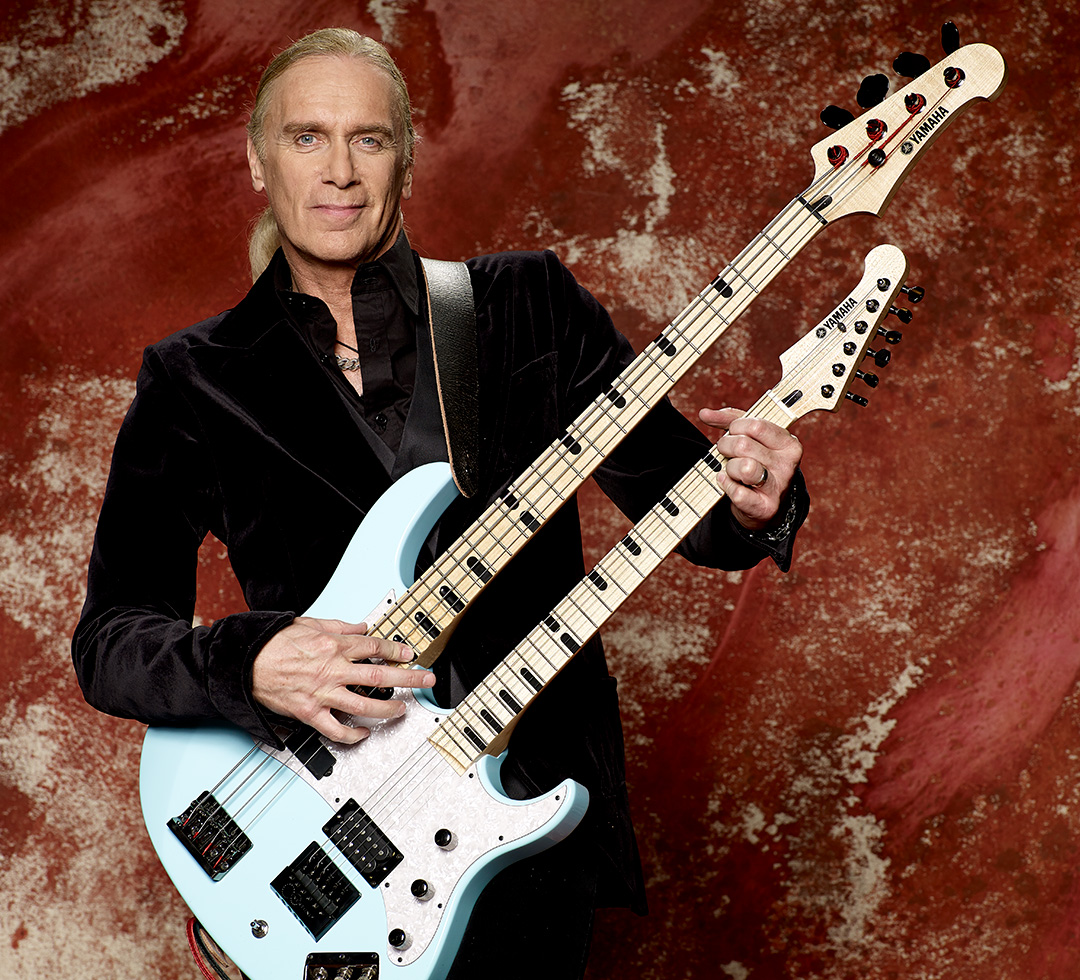
If you’ve ever seen a man wrestling a bass guitar like it’s a wild animal—and winning—you were probably watching Billy Sheehan. To some, he’s the "Eddie Van Halen of bass," but that’s like calling a Ferrari a "fast bicycle." Billy is a force of nature who redefined what four strings could do while most of us were still trying to figure out how to tune them.
Buffalo Roots and the Birth of "The Wife"
Billy didn't just appear out of a puff of stage smoke; he was forged in the blue-collar winters of Buffalo, NY. Growing up in the "Queen City," Billy was surrounded by a thriving local music scene. It wasn't about fame then; it was about survival in the clubs. He often talks about the work ethic of Buffalo—a place where you played hard or you didn't play at all.
His first real instrument wasn't some high-end custom shop piece. It was a Hagstrom bass, but the legend truly begins with a heavily modified Fender Precision Bass he nicknamed "The Wife." He scalloped the frets with a Dremel tool (very poorly, by his own admission), added a "mudbucker" pickup in the neck, and used washers to keep the input jack from falling out. That bass was salty—literally—from years of soaking in his "brine sweat" during club sets. It was his laboratory for every crazy idea he had about how a bass should sound.
Why Bass? (And Why Not Guitar?)
It’s a common myth that every bassist is just a failed guitar player. In Billy’s case, he actually is a highly skilled guitar player, but he chose the bass because it simply "interested him way more." He liked the control it provided over the band’s foundation.
He realized early on that the bass was the "intangible" engine. While the guitarist gets the glory, the bassist decides how the house is built. He stayed with the bass to prove it could be a lead instrument without losing the groove. He brought neoclassical influences—think Bach and Paganini—into the rock world, using three-finger picking and two-handed tapping techniques that made other musicians drop their picks in confusion. He wanted the bass to have the agility of a violin and the power of a semi-truck.
The Talas Years: Buffalo’s Best Kept Secret
In the early '70s, Billy formed Talas, a hard-rock trio that became legendary in Western New York. He found members like drummer Mark Miller and vocalist Phil Naro through the tight-knit Buffalo circuit. Talas wasn't just a band; they were a masterclass in "making it" through sheer volume of work. They conquered the club scene, often playing five sets a night, which is why Billy is still one of the tightest players on the planet.
- Talas (1979)
- Sink Your Teeth into That (1983)
- Live Speed on Ice (1985)
- 1985 (Released in 2022, featuring "lost" tracks from the original lineup)
The David Lee Roth "Eat 'Em and Smile" Era
In 1985, Billy got the call that changed everything: David Lee Roth had left Van Halen and wanted a "supergroup." Billy actually suggested Steve Vai for the guitar spot after the first choice didn't work out. The chemistry between Billy and Steve Vai was explosive; they were like two lead guitarists playing in perfect, terrifying harmony.
However, the honeymoon didn't last. During the recording of the follow-up album, Skyscraper, Billy grew frustrated. He wasn't a fan of the heavy use of synthesizers and the "over-produced" sound that moved away from the raw, aggressive rock of their debut. He felt the bass was being buried under layers of keys. There were also the usual "ego clashes" that happen when you put three alphas in a room. Billy eventually left to form his own project, Mr. Big, which would go on to have a massive #1 hit with "To Be With You."
The Engineering of Tone: Yamaha, DiMarzio, and EBS
Billy isn't just a player; he’s an engineer of tone. He doesn't just buy gear; he co-creates it.
The Yamaha Attitude Bass and Pickups
Billy has worked with Yamaha for over 30 years to develop the Attitude series. It’s essentially a "factory version" of "The Wife," but built with Japanese precision.
- The Pickups: It features a Yamaha-designed DiMarzio Woofer pickup at the neck and a DiMarzio Will Power split-coil in the middle.
- The High-Cut Switch: A push/pull switch on the tone knob activates a high-cut filter on the woofer pickup, giving him that massive, sub-low "dub" sound while the middle pickup handles the bite.
- Scalloped Frets: The frets from 17 to 21 are hollowed out, allowing Billy to "grab" the string for massive bends.
- Miter Bolting: The neck is held on by five screws, two of which are at an angle, fusing the neck to the body for insane sustain.
The EBS Billy Sheehan Signature Drive
Collaborating with EBS Sweden, Billy created a pedal that distills his entire rack-mount signal chain into one box. It allows for Parallel Processing, splitting your signal into two paths so you never lose your "thump."
- Billy's Go-To Settings: For a classic "Sheehan growl," try setting the Drive to 1 o’clock, Tone to 10 o’clock, and the Compression switch to the "Mid" position.
- Phase Inverter: A genius addition that ensures the clean and dirty signals don't cancel each other out—a common problem for bassists using distortion.
The Amplifier Rig
Billy is a Hartke man through and through, typically using the LH1000 heads. His rig is a "bi-amp" masterpiece:
- Channel 1 (Clean): Driven by the neck "woofer" pickup, this stays deep and clean to provide the foundation.
- Channel 2 (Dirty): This takes the middle pickup signal and runs it through a Pearce BC-1 preamp (or a modeled version on his Line 6 Helix) to get that signature high-mid distortion.
- The "Smiley Face" EQ: He often uses a slight "reverse smiley" (boosting mids) on the dirty side to ensure his fast runs cut through the wall of guitars.
The Man Behind the Bass: Wine, Food, and Business
When he’s not on tour (which he loves—he’s a self-proclaimed "road dog"), Billy has a surprisingly sophisticated "business mind." He’s known for being very hands-on with his career, social media, and fan interactions. He treats his music career like a craftsman treats a workshop—organized, deliberate, and professional.
He’s also a man of refined tastes:
- Red Wine: He has a deep appreciation for a good vintage and often shares his favorites with fans.
- Cooking: Billy loves to cook and considers food an art form similar to music.
- Home Base: After living in Los Angeles for 32 years, Billy moved to Nashville around 2017. He found the "Music City" vibe more conducive to his lifestyle and the thriving community there.
What They Say About Him
Musicians like Mike Portnoy and Paul Gilbert often talk about Billy’s work ethic. Portnoy once remarked that Billy is the "easiest guy to work with but the hardest guy to keep up with." Fans describe him as one of the most approachable "rock stars" in the business. He doesn't look at fans as "customers"; he looks at them as friends who have supported his 50-year journey.
The Legacy of Billy Sheehan
Billy Sheehan’s legacy is not just about notes played faster than most thought possible. It is about redefining a role, honoring tradition while challenging assumptions, and proving that intellect and intensity can coexist.
From Buffalo to the world, from classical piano to roaring amplifiers, Billy Sheehan remains a musician driven not by ego, but by curiosity—and by an unshakable love for music itself.
And that, more than anything, is why he still matters.
As the hosts of the Rockin' Roundtable, Shay and Mattias, would surely agree: Billy Sheehan isn't just a bass player; he’s the architect of modern rock virtuosity.